
How to Delegate Tasks: 7 Steps to Stop Doing Everything
You handed off the task. Why are you still answering every question about it? Learning how to delegate tasks starts with making the decisions around the work as clear as the work itself.
“Handle tomorrow’s schedule” can sound perfectly clear to an owner who knows every customer, employee, and exception. To someone else, it may mean twenty unanswered questions—and twenty interruptions for you.
Start here: choose one repeatable task, define a finished result, assign an owner, agree on decision limits, and schedule a review. Test the handoff on a small batch before expanding it.
The schedule is assigned. Every decision still waits.
Fictional example: A cleaning-company owner asks a coordinator to prepare next week’s visits. By lunchtime, the coordinator has questions about travel time, a customer’s preferred arrival window, a missing employee, and whether a longer job can move to Friday.
The owner answers each message, rearranges the draft, and finally takes over. The coordinator learns that the safest move is to ask before changing anything. Next week, the same pattern repeats.
One useful repair is to define what the coordinator can decide: use approved arrival windows, leave the agreed travel buffer, and move a visit only within the customer’s accepted dates. Staffing shortages and unapproved customer requests go back to the owner. Now the coordinator has both a task and a boundary.
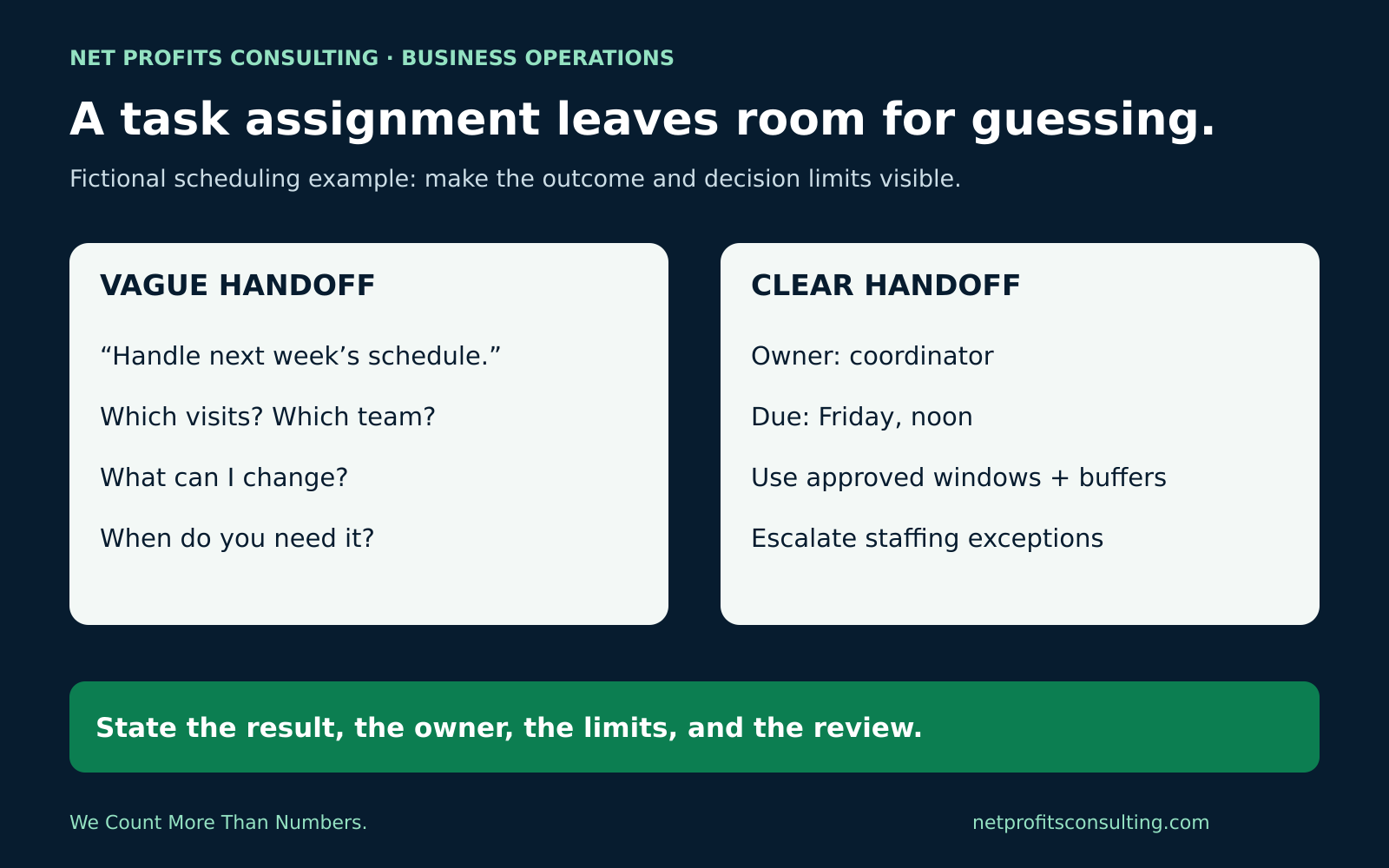
The handoff needs an outcome, authority, and a review
The Center for Creative Leadership’s delegation guidance emphasizes authority, resources, direction, and support—not just assigning work. It also recommends agreeing on how completion will be assessed.
For a small business, translate that into three practical questions: What does finished look like? What can this person decide? When will we check the result? The worksheet below is a Net Profits practice tool for answering those questions. It is not a validated assessment or a promise of a particular productivity gain.
How to delegate tasks in seven practical steps
1. Choose one task with a clear finish line
Start with work that happens often and can be checked without recreating it. Examples include preparing a draft schedule, compiling missing-document requests, or assembling a weekly status report.
Avoid using your first trial for a task with unclear requirements or consequences the person cannot yet manage. You can split a sensitive process: someone may prepare a report while an authorized person retains approval. Delegating preparation does not automatically delegate approval.
Write down: the task, how often it happens, how long it currently takes you, and what would go wrong if it were late or incorrect.
2. Check the person’s capacity before adding the work
Ask what is already due. Agree on what this task replaces, where it fits, and which skills or tools are missing. “You own this now” is not a capacity plan if every hour is already committed.
For the coordinator, reserve a scheduling block and identify a backup for incoming calls during that time. If interruptions make the block impossible, fix that conflict before judging the handoff.
3. Show what a finished result looks like
Provide one completed example and a short checklist. In our scheduling scenario, a finished draft includes every confirmed visit, approved time windows, an assigned team, travel buffers, and a separate list of unresolved exceptions.
Ask the coordinator to explain the requirements back in their own words. Then use one sample visit to test the interpretation. A misunderstanding discovered here is cheaper to repair than a full week of incorrect scheduling.
Distinguish essential standards from personal preferences. A correct, usable schedule should not fail review simply because someone used a different highlight color.
4. State the decision limits explicitly
Use one of these permission statements for each part of the work. These are practical labels for your handoff, not universal rules:
- Prepare and recommend: gather the facts and propose an option; wait for approval before acting.
- Act within agreed limits: complete routine work within written boundaries, then report the result.
- Pause and escalate: stop the affected step and contact the designated person when an exception appears.

In the example, moving a confirmed visit within an already approved window is routine. Assigning an unavailable employee is not. Define the contact channel, backup approver, and latest useful response time. “Ask me if anything happens” is too vague to guide a busy day.
Give the person the access they need for the assignment through their own account where possible. Match permissions to their role and keep approvals for spending, customer commitments, or sensitive changes explicit.
5. Set checkpoints that can catch a problem early
For the first schedule, review three sample entries before the coordinator builds the rest. Then check the full draft before it is sent. After repeated accurate work, you may reduce routine checks while continuing to review exceptions.
Agree on a simple update format: completed work, next step, blocker, and decision needed. If an urgent exception occurs, use the escalation channel instead of waiting for the next routine update.
The goal is enough visibility to correct the work before it causes a problem. Constant unscheduled status requests can make the owner the interruption instead.
6. Review the result without silently taking the task back
Compare the output with the agreed checklist. If travel time is missing, identify that gap, show one correction, and ask the coordinator to check the remaining visits. Quietly fixing everything yourself hides the learning opportunity and leaves the process unchanged.
If the deadline is at risk, agree on a recovery plan. Sometimes you must intervene to protect the customer. Afterward, record what happened and decide whether the problem was unclear instructions, missing information, insufficient practice, or insufficient time.
Recognize accurate work and sound judgment as specifically as you discuss errors. “You flagged the staffing conflict before confirming the visit” tells the person what to repeat.
7. Measure whether the handoff actually helps
Track owner time, employee time, rework, missed deadlines, and whether the result meets the agreed standard. A task completed by someone else is not automatically a successful delegation if the owner spends just as long repairing it.
An illustrative time check
Suppose the owner previously spent 120 minutes a week on the task. After the handoff, review and support take 45 minutes. That releases 75 owner minutes per week.
If initial training used 180 owner minutes, 180 ÷ 75 = 2.4 weeks to recover that owner-time investment, assuming the savings persist. After three full weekly cycles, 225 minutes would be released—45 minutes more than the initial training time.
This is owner capacity, not automatic payroll savings or profit. Employee time, wages, quality, and any new tools still matter. Decide what useful work will fill the owner’s released time.
How to delegate tasks with a one-page handoff
Copy these prompts into your shared document or task system. Complete them together before the trial begins.
| Field | Write this |
|---|---|
| Outcome and purpose | What must be finished, and who needs it? |
| Owner and backup | Who completes the work, and who covers an absence? |
| Inputs and access | Which records, example, checklist, and permissions are needed? |
| Decision limits | What can the person do independently? What needs approval? |
| Deadline and review | When is the first check? When is the final result due? |
| Exceptions and proof | When should work pause, who responds, and where is completion recorded? |
Scheduling example: “Jordan prepares next week’s visit schedule by Friday at noon using the confirmed-job list. The first three entries are reviewed Thursday. Jordan can use approved windows and team availability; shortages or unapproved date changes go to the owner. The final draft and exception list stay in the shared scheduling folder.” Jordan and this business are fictional.
Try one handoff for two weeks
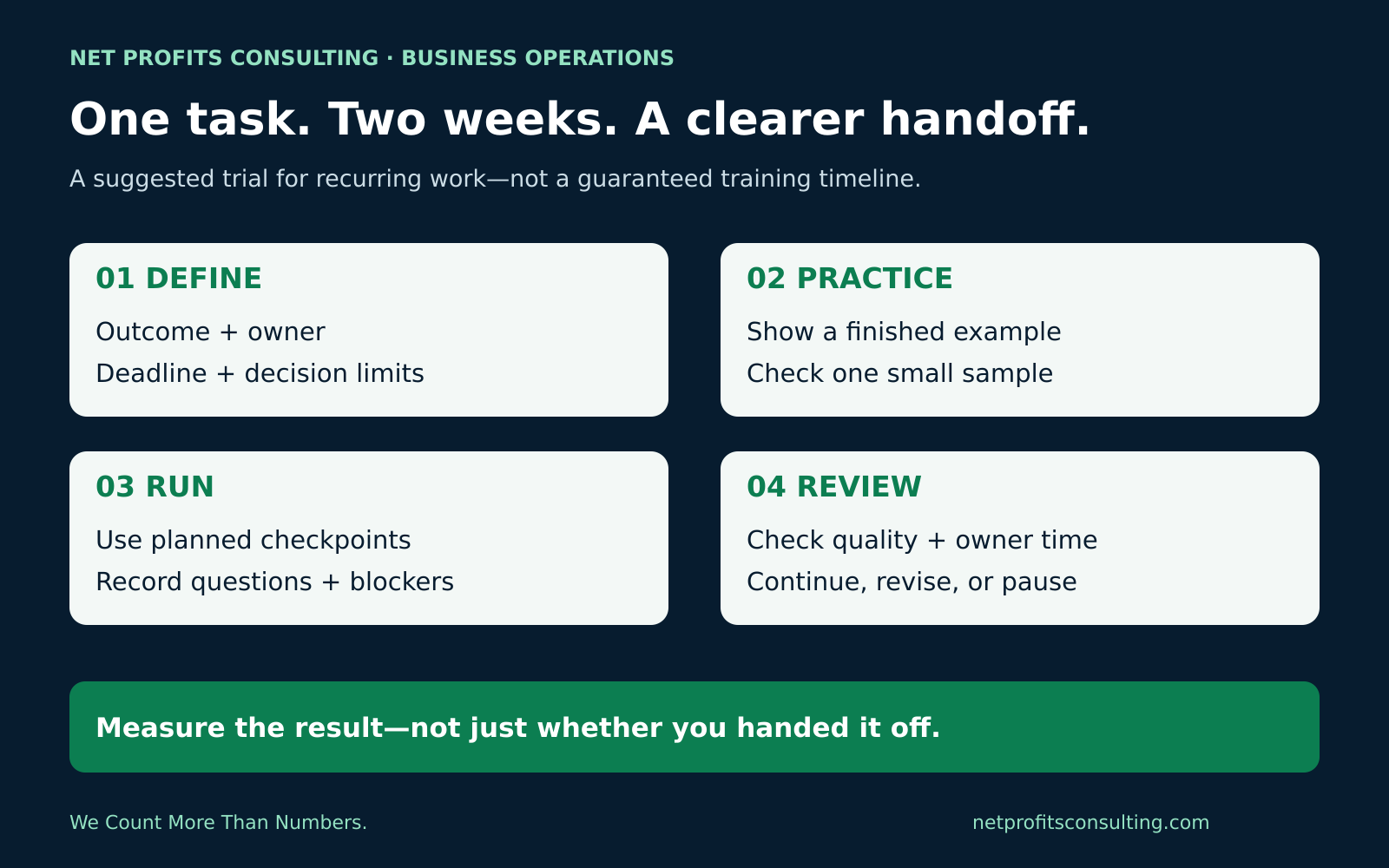
During week one, record the starting time requirement, prepare the handoff, and complete a guided run. During week two, let the person perform the agreed work with the planned checkpoints. Keep a short question log so repeated questions become improvements to the instructions.
At the end, choose one of three outcomes: continue with the same support, revise and repeat, or pause because the task or person’s capacity is not ready. One successful attempt is useful evidence, but it is not proof that all review can stop.
If you need broader support tools, explore our business courses. Start with the operating problem and choose education that supports it.
Common delegation questions
What if I can do it faster myself?
You may be faster during training. Compare the repeated future workload with the time required to teach and review it. Start with one recurring task and measure the result instead of assuming every handoff will save time immediately.
What if the same question keeps coming back?
Ask whether the answer is missing, hard to find, contradictory, or outside the person’s authority. Repair that specific gap. More reminders will not fix instructions that require guessing.
Can I delegate if I have no employees?
You can use the same handoff questions with an appropriately engaged service provider or partner. Agree on deliverables, access, price, and responsibilities. Do not assume an outside provider has unlimited capacity or authority to act for your business.
Choose one task that should stop depending on you.
Net Profits Consulting helps business owners improve workflows, accountability, and operating systems. Bring one recurring task, the questions that keep returning, and an example of the finished work you need.
Explore Operations Consulting →We Count More Than Numbers.
Keep building a business that runs better
Get practical business education and resource updates.
Source reviewed September 28, 2026. Scenarios, names, and time estimates are fictional teaching examples. Adapt the worksheet to your business; it does not replace required professional approvals or existing agreements.

Leave a Reply