
Start your small business with a clear plan
Work through the steps for business structure, startup costs, banking, bookkeeping, and daily operations. Use the roadmap to decide what to do next.
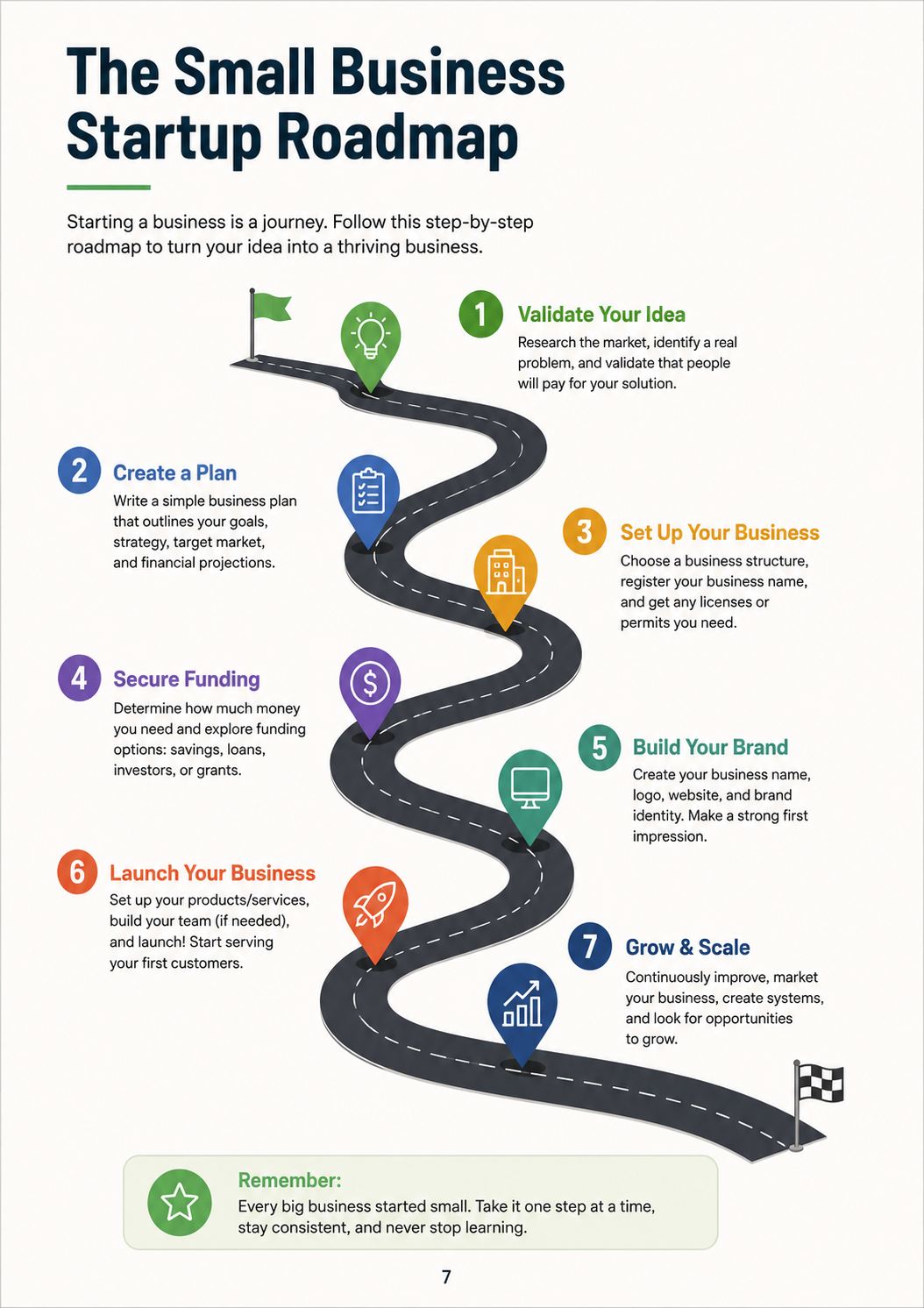
Seven stages to start a small business and build toward growth.
To start a small business successfully, move through the major decisions in sequence so the company grows on a stronger foundation.
Validate
Confirm the customer, problem, offer and willingness to pay.
Plan
Define the revenue model, costs, goals and operating assumptions.
Set Up
Choose the structure, register the business and address licenses.
Fund
Estimate startup capital and choose appropriate funding sources.
Build the Brand
Create the name, message, website and customer-facing identity.
Launch
Begin serving customers and test the operating assumptions.
Grow & Scale
Improve systems, profitability, capacity and repeatable growth.
See how to start a small business from idea to growth.
The Small Business Startup Roadmap helps organize how to start a small business into a practical sequence. Validate the idea, create a plan, set up the business, secure funding, build the brand, launch and then strengthen the systems needed to grow.
A checklist to start a small business should go beyond filing the LLC.
Entity formation matters, but it is only one part of the process to start a small business. Banking, bookkeeping, pricing and operating systems deserve attention too.
Business Formation
Choose an entity structure based on ownership, liability, tax and operating considerations.
- Business name
- Entity structure
- State registration
- EIN
- Ownership agreements
- Required licenses
Business Banking
Separate business activity from personal activity as early as practical.
- Business checking
- Business savings
- Payment processor
- Credit card
- Deposit workflow
- Owner contribution tracking
Bookkeeping System
Do not wait until tax season to decide how financial records will be organized.
- Accounting software
- Chart of accounts
- Receipt process
- Bank feeds
- Reconciliation schedule
- Financial reporting
Pricing & Profit Model
Revenue is not enough. Understand what the business needs to charge to cover costs and create profit.
- Direct costs
- Overhead
- Target margin
- Markup
- Break-even
- Sales targets
Licenses, Insurance & Risk
Identify the registrations, permits and insurance appropriate for the business and location.
- Industry licenses
- Local permits
- Sales tax registration
- General liability
- Workers’ compensation
- Other industry-specific coverage
Business Systems
Build a small number of repeatable processes before the business becomes more complicated.
- Sales process
- Customer onboarding
- Payment collection
- Expense approval
- Document storage
- Weekly owner review
Estimate what you need before you start a small business.
Startup costs vary widely by industry. Before you start a small business, separate one-time setup expenses from recurring operating expenses so you can estimate how much cash may be needed for the early months.
Open the Business Calculators →Before you start a small business, define what startup funding must accomplish.
Funding should solve a defined business need. Before using debt, grants or outside capital to start a small business, determine the amount required, the expected use of funds and how the business will support the obligation.
Owner Capital
Many businesses begin with some combination of owner savings, contributions or reinvested early revenue.
Loans & Credit
Borrowed capital creates repayment obligations, so cash-flow capacity matters as much as approval.
Grants & Programs
Grants can be useful when eligibility fits, but they should not replace a complete startup plan.
Mistakes made when you start a small business can become expensive later.
Mixing Personal and Business Funds
Separate the activity early so records are easier to understand.
Choosing a Price by Guessing
Know the cost, margin and break-even requirement behind the price.
Waiting Until Tax Season
Bookkeeping should support decisions throughout the year.
Spending All Startup Cash
Opening the business without working capital can create immediate pressure.
Buying Too Much Software
Use technology to support a defined workflow, not because an app looks useful.
Hiring Before the Process Is Clear
Document the work before expecting someone else to perform it consistently.
Borrowing Without a Use-of-Funds Plan
Capital should have a clear purpose and expected business outcome.
Falling in Love With a Location
Make sure occupancy cost fits the business economics before committing.
Run the numbers before you start a small business.
Margin & Markup Calculator
Understand the difference between markup and gross margin.
Calculate Pricing →Break-Even Calculator
Estimate how much the business must sell to cover costs.
Calculate Break-Even →Cash Runway Calculator
Estimate how long available cash can support current spending.
Calculate Runway →Loan Payment Calculator
Estimate the payment before adding debt to the business.
Calculate Loan Payment →Practical Next Step
Don’t try to look like a big business on day one. Build a small business that understands its numbers, knows how money moves and can repeat the work consistently. Complexity should come after the foundation—not before it.
Common questions about how to start a small business.
Do I need an LLC to start a business?
Not every business must operate as an LLC. The appropriate structure depends on ownership, liability, tax and operating considerations. Review the available structures before choosing one.
When should I open a business bank account?
Once the business is properly established and eligible to open an account, separating business and personal activity can make financial management and recordkeeping significantly clearer.
When should I start bookkeeping?
Start when business financial activity begins. Waiting until tax season can make it harder to understand performance and correct problems.
How do I know what to charge?
Start with direct cost, overhead, target margin, market positioning and break-even requirements rather than simply copying a competitor’s price.
Should I get a business loan before opening?
That depends on the capital requirement and the business’s ability to support repayment. Define the use of funds and projected cash flow before adding debt.
What software does a new business need?
Start with the fewest tools required to handle accounting, payments, communication and core operations. Add software only when a real workflow problem justifies it.
Can Net Profits help me set up the financial side of my business?
Net Profits can support entrepreneurs who want to start a small business with bookkeeping setup, QuickBooks, financial systems, business consulting and other startup-related financial and operating needs.
Get useful startup resources and opportunities.
Receive startup guidance, funding opportunities, practical tools and business updates to help you build on a stronger foundation.
Start a small business with the financial foundation already in place.
If you need help organizing the books, pricing, financial systems or startup decisions, start with a short conversation.