

Accounting Basics for Business Owners
Understand what your business earns, owns, and owes.
Get the Free GuidesSee what is inside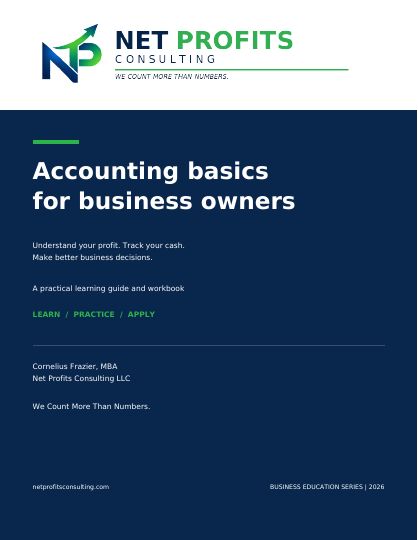
Start with the question in front of you.
First-time owners who want a clear starting point for their business finances.
This NP guide combines plain-language explanations, fictional business examples, and practice activities. Read the example, try the exercise, then compare your reasoning with the explanation provided.
What you will learn
- Organize the five main account families.
- Separate revenue, profit, and cash.
- Use a monthly review to choose your next action.
A useful idea before you download
A bank deposit is not always revenue. Owner contributions and loan proceeds increase cash without becoming sales. Start with the reason for the transaction, then choose the account.
Follow the numbers
A business receives a $5,000 loan. Cash rises by $5,000 and the loan liability rises by $5,000. Revenue does not change.
Depreciation: where each number comes from
The guide uses separate fictional equipment examples. Keep each set of assumptions together:
- Cleaning-business case: $6,000 cost − $0 residual value = $6,000 to allocate. Five years × 12 = 60 months. $6,000 ÷ 60 = $100 for one full month. With no earlier depreciation, $6,000 − $100 = $5,900 equipment carrying amount.
- Separate machine example: $9,600 cost − $600 estimated residual value = $9,000 to allocate. $9,000 ÷ five years = $1,800 per year; $1,800 ÷ 12 = $150 per full month.
- Practice question: $8,400 cost, $0 residual value, and seven years × 12 = 84 months. $8,400 ÷ 84 = $100 per full month.
The amounts differ because the assumed costs, residual values, and useful lives differ. None of these monthly entries is a new payment for the equipment.
How to support your own numbers: Use the purchase invoice and asset register for recorded cost, documented estimates for useful life and residual value, the date the asset became ready for use for timing, and the depreciation schedule for the charge already recorded. Residual value means estimated value at the end of the useful life. These are simplified book examples using straight-line depreciation and full months; tax calculations can differ.
Try this in your business
Choose five recent bank transactions. Identify the business purpose and supporting record for each before accepting its category.
Keep a note of the evidence you used and the question you still need to resolve. Bring that question to your next bookkeeping review.
How to use the guide
- Read the explanation and worked example.
- Complete the practice before checking the answer.
- Choose one action for your next financial review.
A common question
Does a positive bank balance mean my business is profitable?
No. Cash can come from loans, owner contributions, or collections of older invoices. Review revenue and expenses for the same period to assess profit.
Need help with your own books?
Use the guides to understand the work, then get support with QuickBooks Online setup, cleanup, or monthly bookkeeping.
Explore bookkeeping supportTake the free bookkeeping courseKeep learning
Browse all 11 accounting and bookkeeping guides or use the NP business calculators to explore a related decision.
Get the Free GuidesEducational material with illustrative examples. Apply the appropriate rules and facts to your business. © 2026 Net Profits Consulting LLC. We Count More Than Numbers.