

Accounting Equation for Business Owners
Explain every transaction with assets, liabilities, and equity.
Get the Free GuidesSee what is inside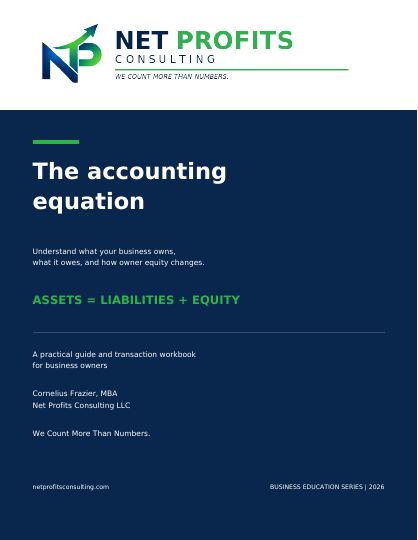
Start with the question in front of you.
Owners learning how transactions connect to the balance sheet.
This NP guide combines plain-language explanations, fictional business examples, and practice activities. Read the example, try the exercise, then compare your reasoning with the explanation provided.
What you will learn
- Apply assets = liabilities + equity.
- Trace owner funding, borrowing, income, and expenses.
- Check the equation with worked examples and practice.
A useful idea before you download
The equation is a way to explain changes in financial position. A balanced result is a useful check, but it does not prove that every transaction was classified correctly or recorded in the right period.
Follow the numbers
If assets are $50,000 and liabilities are $18,000, equity is $32,000: $50,000 − $18,000 = $32,000.
Depreciation: where each number comes from
In the guide’s complete case, the $100 expense comes from these stated assumptions:
- Equipment cost: $5,000.
- Estimated residual value after four years: $200.
- Cost to allocate: $5,000 − $200 = $4,800.
- Useful life: four years × 12 = 48 months.
- One full month: $4,800 ÷ 48 = $100 depreciation.
After the first month, equipment’s carrying amount is $5,000 − $100 = $4,900. The $100 expense lowers profit and equity by $100 and reduces net assets by $100. The depreciation entry itself changes cash by $0.
How to support your own numbers: Use the purchase invoice and asset register for recorded cost, documented estimates for useful life and residual value, the date the asset became ready for use for timing, and the depreciation schedule for the charge already recorded. Residual value means estimated value at the end of the useful life. These are simplified book examples using straight-line depreciation and full months; tax calculations can differ.
Try this in your business
Choose one purchase, one customer payment, and one owner transaction. Name the accounts affected and explain how the equation remains balanced.
Keep a note of the evidence you used and the question you still need to resolve. Bring that question to your next bookkeeping review.
How to use the guide
- Read the explanation and worked example.
- Complete the practice before checking the answer.
- Choose one action for your next financial review.
A common question
Is equity the same as cash available to withdraw?
No. Equity is the residual accounting interest after liabilities are deducted from assets. It may be represented by equipment, inventory, or receivables rather than cash.
Need help with your own books?
Use the guides to understand the work, then get support with QuickBooks Online setup, cleanup, or monthly bookkeeping.
Explore bookkeeping supportTake the free bookkeeping courseKeep learning
Browse all 11 accounting and bookkeeping guides or use the NP business calculators to explore a related decision.
Get the Free GuidesEducational material with illustrative examples. Apply the appropriate rules and facts to your business. © 2026 Net Profits Consulting LLC. We Count More Than Numbers.