

Balance Sheet for Business Owners
Read what the business owns, owes, and retains at a point in time.
Get the Free GuidesSee what is inside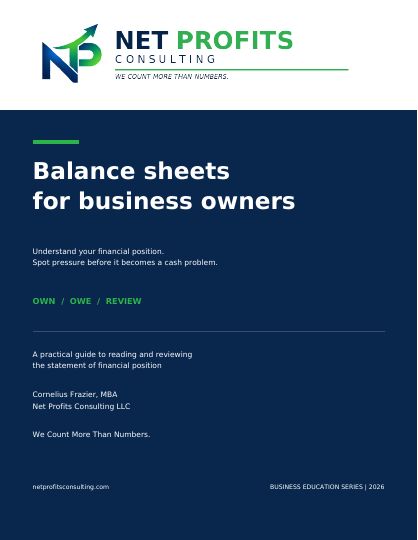
Start with the question in front of you.
Owners preparing for a financial review, financing conversation, or monthly close.
This NP guide combines plain-language explanations, fictional business examples, and practice activities. Read the example, try the exercise, then compare your reasoning with the explanation provided.
What you will learn
- Read current and noncurrent balances.
- Explain changes in liabilities and equity.
- Use liquidity measures and evidence checks.
A useful idea before you download
The balance sheet is a dated snapshot. Read it alongside the income statement and cash-flow information. A large asset balance is not automatically spendable cash, and a balanced report can still include unsupported or misclassified amounts.
Follow the numbers
Assets of $113,000 less liabilities of $67,000 leave equity of $46,000. The equation checks: $113,000 = $67,000 + $46,000.
Depreciation: where each number comes from
The PDF gives $36,000 equipment cost and $9,000 accumulated depreciation. The $9,000 is a supplied balance of depreciation recorded to date; the PDF does not specify the asset’s useful life or age.
Carrying amount: $36,000 − $9,000 = $27,000.
One possible supporting schedule, added for teaching: Assume $0 residual value, a four-year useful life, straight-line depreciation, and one full year of use from a zero accumulated balance. $36,000 ÷ four = $9,000 per year; $9,000 ÷ 12 = $750 per month; $750 × 12 = $9,000 accumulated depreciation. These added assumptions illustrate how the balance could arise; they are not facts supplied in the PDF.
The $27,000 carrying amount is neither a bank balance nor a guaranteed selling price. Accumulated depreciation is the total recorded allocation of cost, not cash saved for replacement.
How to support your own numbers: Use the purchase invoice and asset register for recorded cost, documented estimates for useful life and residual value, the date the asset became ready for use for timing, and the depreciation schedule for the charge already recorded. Residual value means estimated value at the end of the useful life. These are simplified book examples using straight-line depreciation and full months; tax calculations can differ.
Try this in your business
Pick the three largest balances on your latest report. Identify the document or schedule that supports each amount.
Keep a note of the evidence you used and the question you still need to resolve. Bring that question to your next bookkeeping review.
How to use the guide
- Read the explanation and worked example.
- Complete the practice before checking the answer.
- Choose one action for your next financial review.
A common question
Does the balance sheet show what my business could sell for?
Not by itself. Accounting balances follow recognition and measurement rules; they are not a complete market valuation of the business.
Need help with your own books?
Use the guides to understand the work, then get support with QuickBooks Online setup, cleanup, or monthly bookkeeping.
Explore bookkeeping supportTake the free bookkeeping courseKeep learning
Browse all 11 accounting and bookkeeping guides or use the NP business calculators to explore a related decision.
Get the Free GuidesEducational material with illustrative examples. Apply the appropriate rules and facts to your business. © 2026 Net Profits Consulting LLC. We Count More Than Numbers.