

Financial Ratios for Business Owners
Turn financial measures into better operating questions.
Get the Free GuidesSee what is inside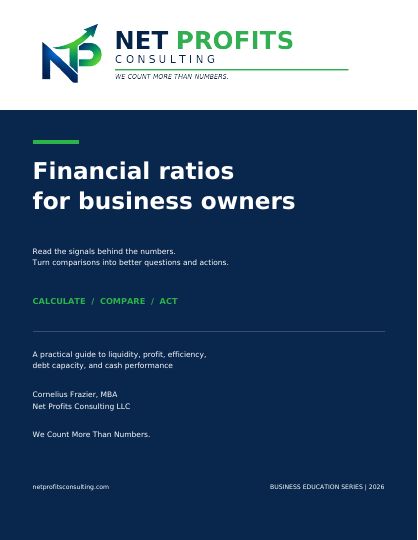
Start with the question in front of you.
Owners comparing liquidity, profitability, collections, debt, and cash performance.
This NP guide combines plain-language explanations, fictional business examples, and practice activities. Read the example, try the exercise, then compare your reasoning with the explanation provided.
What you will learn
- Calculate measures from one consistent fictional data set.
- Distinguish margins, returns, turnover, and coverage.
- Write a formula and action plan for each selected measure.
A useful idea before you download
A ratio is most useful when its definition, period, and comparison are clear. Review changes over time, investigate the drivers, and avoid treating one number as a complete judgment about the business.
Follow the numbers
Given: Current assets are $180,000 and current liabilities are $100,000.
- Current ratio: $180,000 ÷ $100,000 = 1.8 to 1, or $1.80 of current assets for each $1 of current liabilities.
- Working capital: $180,000 − $100,000 = $80,000.
The ratio is a comparison; working capital is a dollar amount. Current assets may include receivables and inventory, so neither result means $80,000 is available in the bank or tells you when customers will pay.
Depreciation: where each number comes from
In the PDF’s Harbor Supply annual case, $180,000 operating expenses include $12,000 depreciation. The $12,000 is supplied example data; the PDF does not include the underlying asset schedule.
One possible schedule, added for teaching: Assume existing equipment cost $60,000, $0 residual value, a five-year useful life, and 12 full months of use. $60,000 ÷ five = $12,000 annual depreciation; $12,000 ÷ 12 = $1,000 monthly. These are added illustrative assumptions, not asset facts supplied in the PDF.
Expense breakdown: $180,000 total operating expenses − $12,000 depreciation = $168,000 other operating expenses. Do not assume all $168,000 was paid in cash; the annual case uses accrual accounting.
Profit check: $600,000 sales − $360,000 cost of goods sold = $240,000 gross profit. $240,000 − $180,000 operating expenses = $60,000 operating profit. $60,000 − $10,000 interest − $10,000 income tax expense = $40,000 net income. Depreciation is already inside the $180,000, so do not subtract it again.
The PDF separately supplies $48,000 operating cash flow. Adding $12,000 depreciation to $40,000 net income gives $52,000, not $48,000: the other operating adjustments must net to −$4,000. That is the implied difference, not an itemized cash-flow reconciliation; the supplied data does not identify every component.
How to support your own numbers: Use the purchase invoice and asset register for recorded cost, documented estimates for useful life and residual value, the date the asset became ready for use for timing, and the depreciation schedule for the charge already recorded. Residual value means estimated value at the end of the useful life. These are simplified book examples using straight-line depreciation and full months; tax calculations can differ.
Try this in your business
Choose three measures tied to decisions you make. Record the formula, reporting period, comparison, and action if the result changes.
Keep a note of the evidence you used and the question you still need to resolve. Bring that question to your next bookkeeping review.
How to use the guide
- Read the explanation and worked example.
- Complete the practice before checking the answer.
- Choose one action for your next financial review.
A common question
Is there one good ratio target for every business?
No. Operating cycle, industry, business model, accounting choices, and seasonality affect interpretation. Use relevant comparisons and supporting details.
Need help with your own books?
Use the guides to understand the work, then get support with QuickBooks Online setup, cleanup, or monthly bookkeeping.
Explore bookkeeping supportTake the free bookkeeping courseKeep learning
Browse all 11 accounting and bookkeeping guides or use the NP business calculators to explore a related decision.
Get the Free GuidesEducational material with illustrative examples. Apply the appropriate rules and facts to your business. © 2026 Net Profits Consulting LLC. We Count More Than Numbers.