
Lead Follow-Up: 5 Steps to Stop Losing Inquiries
Lead follow-up can break down in an ordinary workday. Your phone rings. Someone requests a quote. You promise to get back to them—and the day swallows the conversation.
Lead follow-up is the process of moving an inquiry toward a useful next decision. It starts with a named owner, a specific next action, and a due time. Before buying more attention, check whether the inquiries you already receive have all three.
The customer called. The next step disappeared.
Fictional example: A small commercial cleaning business receives a request for a weekly office service quote. The owner answers between jobs, writes the address on a notepad, and asks a coordinator to arrange a walkthrough.
The coordinator thinks the owner will confirm the date. The owner thinks the coordinator already did. On Friday, they discover that nobody contacted the prospect. The request was real; the responsibility was unclear.
It would be easy to blame the advertising or decide that the prospect was “just shopping.” However, the team has not tested either explanation. It has found a simpler problem: a request entered the business without a recorded next action.
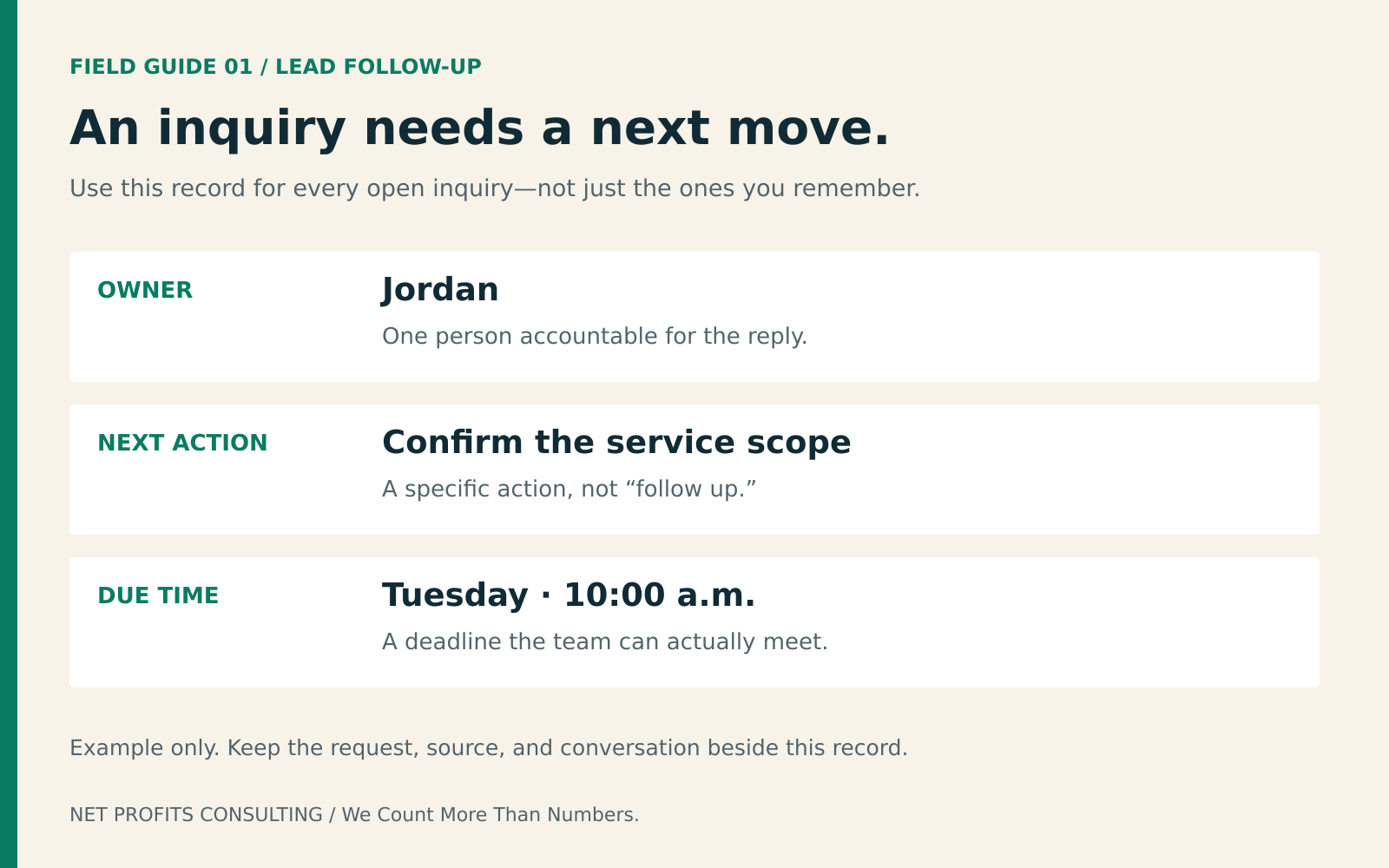
A reply is an activity. A next decision is progress.
“Sent an email” tells you that someone acted. It does not tell you whether the customer received an answer, the job fits your service, or another action is due. Therefore, keep the activity history and the next step together.
For a service business, useful progress might be confirming the address, arranging a walkthrough, sending a scoped quote, or agreeing on a decision date. Sometimes the correct outcome is “not a fit.” Recording that outcome is better than leaving a request open forever.
You can apply this rule in an existing CRM—a system for keeping customer conversations and sales work together—or a shared list for a small volume of inquiries. The process matters before the software choice.
Build your lead follow-up process in five steps
1. Capture the request in one working list
Record the contact, requested service, date received, source, and preferred reply method. Keep the customer’s actual question beside the record so the next person does not have to reconstruct it.
Choose where the team works from. If an inquiry arrives through a form, phone call, or direct message, bring the relevant details into that list. Then check for an existing record before creating another. Three messages from one prospect should not automatically become three new leads.
Owner check: Can you locate every open inquiry without searching several inboxes and a notebook? If not, start by gathering the current requests.
2. Assign one owner and a realistic response window
Give each inquiry one accountable person and a backup for absences. “The office handles it” leaves room for everyone to assume that somebody else replied.
Set a response window that reflects your staffed hours and the urgency of the service. For example, a business might aim to reply within two staffed hours to routine requests. That is a sample operating target, not a universal benchmark or a promise that faster replies guarantee sales.
An automatic receipt can acknowledge the request and explain when a person will respond. However, count that separately from a useful human response. A confirmation email alone does not answer a pricing or scheduling question.
3. Make lead follow-up useful to the customer
Answer what you can, ask for the information you need, and offer one clear next step. For the cleaning inquiry, the missing details might be approximate space size, service frequency, access hours, and a walkthrough time.
“Hi [Name], thank you for asking about weekly office cleaning. To prepare the next step, could you confirm the approximate space size and preferred service days? We can then arrange a walkthrough at a time that works for you.”
Adapt this to the actual inquiry and your availability. Do not offer appointments or services you cannot provide.
Before ending a conversation, agree on what happens next and when. If the prospect asks you to check back next month, record that date. If they decline or ask you to stop contacting them, close or update the record accordingly.
4. Give every open record a next action and due time
Replace “follow up” with something another person can understand: “Ask whether the walkthrough is approved,” “Send the revised scope,” or “Call at the customer’s requested time.”
For an unanswered inbound request, you might send a helpful reminder after two business days and a final check-in several days later. Treat this as a starting example, not a required sequence. Adapt it to the customer’s timing, your service, and the conversation.
Pause reminders when a person replies, books, declines, or changes the timing. In addition, check that two team members are not contacting the same prospect independently. The customer should experience one coherent conversation.
“Hi [Name], are you still planning the office-cleaning walkthrough? If the timing has changed, let me know and I’ll update our record. Otherwise, I’ll close this request for now; you’re welcome to contact us when you’re ready.”
These examples address people who contacted your business. An inquiry is not a reason to enroll someone automatically in unrelated newsletters or keep sending unwanted messages.
5. Review stalled inquiries before increasing the ad budget
At a regular team check, review overdue actions, unanswered requests, pending quotes, and missing outcomes. Ask why each record stopped moving. The cause may be unclear scope, unavailable service, pricing, customer timing, or a missed internal task.
Use concrete outcomes such as won, lost, not a fit, or pending. Also record a reason when you know it. Do not label silence as “too expensive” unless the customer actually said that.
Finally, connect a won job to the delivery handoff. Acceptance, scheduling, paperwork, and payment arrangements still need owners. A successful sales conversation should not create a new operations problem.
Use a lead follow-up scorecard you can explain
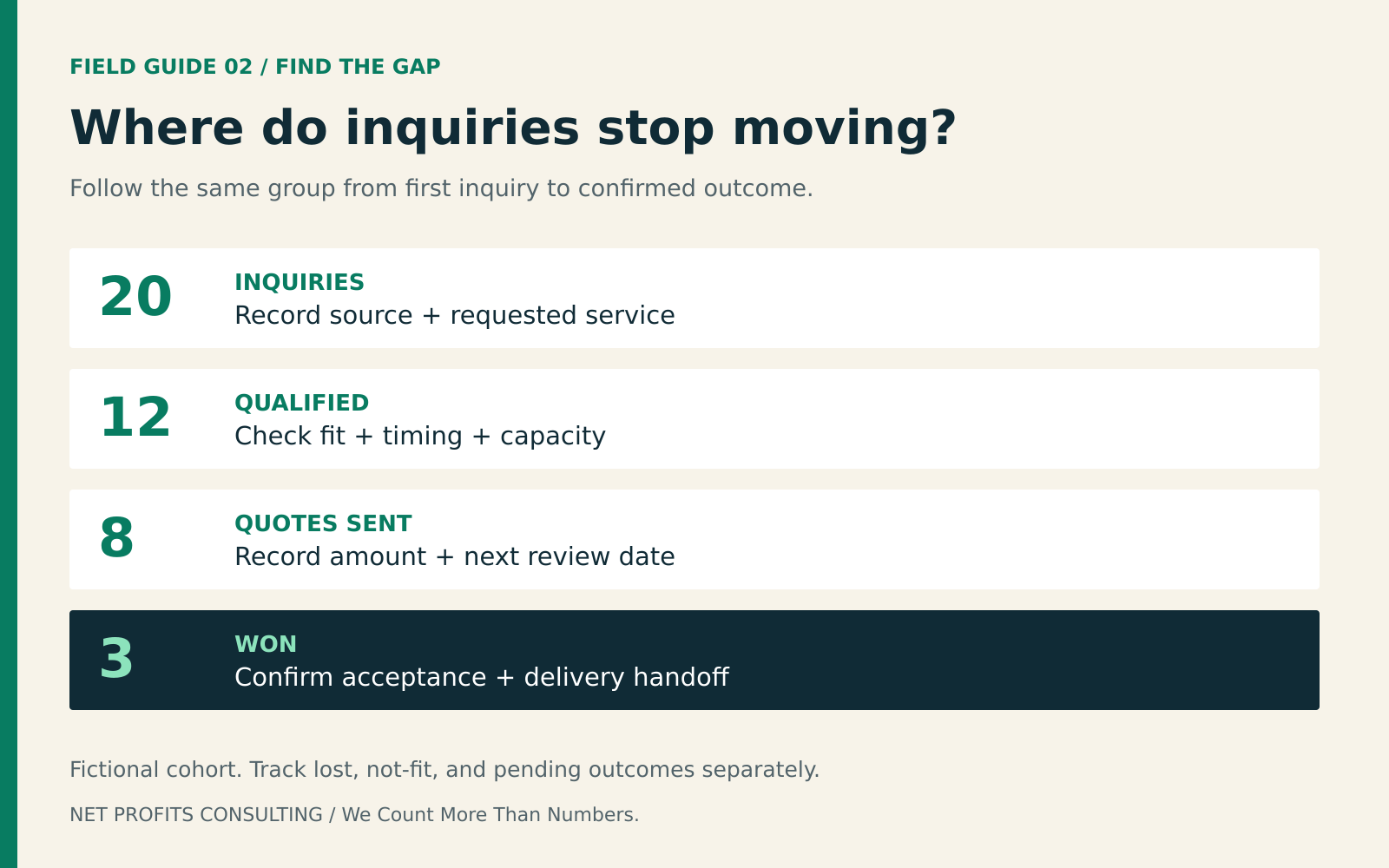
Start with the same group of inquiries and follow their outcomes over time. Mixing this week’s new requests with last month’s completed sales can make a small-business report misleading.
| Measure | Calculation | Question to investigate |
|---|---|---|
| Qualified share | 12 ÷ 20 = 60% | Are requests a fit for our service, location, and capacity? |
| Qualified leads reaching a quote | 8 ÷ 12 × 100 ≈ 66.7% | What prevented the other four from reaching a quote? |
| Quotes won so far | 3 ÷ 8 = 37.5% | Which quotes are lost, and which are still pending? |
Keep the denominator visible: Each row measures a different stage. Across all 20 original inquiries, three wins means 3 ÷ 20 × 100 = 15% won so far. Do not add the stage percentages together. Pending quotes may change the final results.
Do not assume the remaining five quotes were lost. Some may still be pending. Likewise, a booked meeting is not a won job, and a quoted amount is not collected revenue. Keep these definitions separate.
Add two operating checks: the number of open inquiries with no next action, and the number of overdue actions. Track the typical time to the first useful response using a consistent rule for business hours. Compare your own results over time before drawing conclusions from a small sample.
Match partner tools to the actual gap
Affiliate disclosure: Net Profits Consulting may earn a commission if you purchase through the Close or WhatConverts links below. Choose based on your workflow and current product terms; a referral does not guarantee business results.

Close: when follow-up work is scattered
Consider Close when a sales-focused team needs communications and due tasks in a common workspace. Its documented Inbox brings together inbound messages, missed calls, and tasks or reminders.
Test first: Can one person own a request, see its history, and complete the next action? Review current plans, any usage charges, and the features needed for your process.

WhatConverts: when the source is unclear
Consider WhatConverts when you need to connect captured leads with their marketing sources and record lead quality or value. Its documentation distinguishes quote values from sales values and supports qualification records.
Test first: Can you trace a sample inquiry to its source and update its outcome accurately? Check capture coverage, plan fit, and any required connections to your existing systems.

If your existing CRM, including HubSpot, already supports your process, improve that setup before adding a second CRM. Start with one tool decision at a time. There is no requirement to buy either product to use this guide.
For broader context, see our small-business software guide. Match the task, people, and reporting need before comparing features.
Try the process for seven days
First, gather your open inquiries and give each one an owner, next action, and due time. Next, review the list at the start and end of each staffed day. At the end of the week, count records that still lack an action and discuss the reasons behind overdue work.
Use the week to test whether your team can maintain the process. Many sales cycles take longer, so seven days may not establish whether conversion improved. Keep following the same inquiry group until outcomes become clear.
Your copyable lead follow-up record
Contact and request: Who asked, and what do they need?
Source and received time: Where did the inquiry originate?
Owner and backup: Who is responsible?
Status: New, qualifying, quoted, won, lost, not a fit, or pending?
Next action and due time: What happens next, and when?
Outcome and reason: What happened, and what do we know?
Common lead follow-up questions
Do I need a CRM to begin?
No. A shared list may be enough for a small volume if someone keeps it current and access is appropriate. Consider a CRM when ownership, history, reminders, or reporting become difficult to maintain.
How many times should I follow up?
There is no single number that fits every inquiry. Use the customer’s requested timing, the service context, and their responses. Each message should have a purpose, and requests to stop should end the sequence.
Should I automate everything?
Start with a process the team can perform reliably. Then automate a narrow step, such as creating an internal task after an inquiry. Check reply, booking, and closure behavior before relying on a longer sequence.
Bring one stalled inquiry. Build a clearer next step.
Net Profits Consulting helps owners improve workflows, accountability, and business systems. Start with where your inquiries arrive, who responds, and what happens after a quote.
Explore Business Consulting →We Count More Than Numbers.
Keep building a business that runs better
Subscribe for practical business education and resource updates.

Leave a Reply