
Profitable but No Cash? 5 Places to Look First
Profitable but short on cash? A business can earn $8,000 in profit while its bank balance falls from $15,000 to $7,000. Below, we trace the sales, collections, and payments that explain the $8,000 cash decrease—one step at a time.
The short answer: Profit measures revenue less expenses for a period. Cash also moves when customers pay, inventory arrives, equipment is purchased, debt is repaid, and owners take distributions. A profitable month can still drain the bank. The useful question is: Which transactions explain the change?
$8,000 profit, an $8,000 cash decrease, and $7,000 left
Illustrative example—not a client result: A small service company begins the month with $15,000 in cash. It completes and invoices $50,000 of work and records $42,000 of expenses. Some customers have not paid yet, and some cash payments do not count as current-period expenses.
1. Calculate the profit: $8,000
$50,000 revenue − $42,000 expenses = $8,000 profit. This is an accrual-basis result: revenue is recorded when earned, even if the customer has not paid. The expenses include $1,000 of depreciation, which does not require a cash payment this month.
Where does the $1,000 depreciation come from?
The original example supplied $1,000 as an assumed monthly expense without an asset calculation. To make it traceable, use these added teaching assumptions: the company already owns equipment that cost $60,000, expects to use it for five years, and estimates no value remaining at the end of that life. It uses straight-line depreciation, which spreads the depreciable cost evenly. This is a fictional example, not a client asset record.
- Recorded equipment cost: $60,000. In real books, support this with the purchase invoice and capitalized costs in the asset register. Assume it was paid for before this month.
- Estimated residual value: $0. This is the assumed amount remaining at the end of its useful life, not its value today.
- Cost to allocate: $60,000 − $0 = $60,000.
- Estimated useful life: five years × 12 months = 60 months. This is a book estimate for this example, not a universal equipment life or tax rule.
- Monthly depreciation: $60,000 ÷ 60 = $1,000 per full month. Annual check: $1,000 × 12 = $12,000.
What happens this month? Record a $1,000 debit to depreciation expense and a $1,000 credit to accumulated depreciation. That lowers this month’s profit by $1,000 and increases the total depreciation recorded against the equipment by $1,000. The entry pays no cash and does not create a replacement savings account.
Connect it to the $42,000: $41,000 of other expenses paid this month + $1,000 depreciation = $42,000 total expenses. When converting profit to cash flow, add back the $1,000 because it reduced profit without a cash payment this month. The add-back does not deposit $1,000 into the bank.
The separate $2,000 equipment purchase: That is new equipment paid for this month, not the source of this $1,000 charge. For this illustration, assume the new item is not ready for its intended use until next month, so it has no depreciation this month. Its $2,000 payment still reduces cash this month. Book and tax depreciation may differ.
2. Calculate the actual cash movement: −$8,000
| Calculation | Amount |
|---|---|
| Customer cash collected: $50,000 sales − $12,000 still unpaid | $38,000 received |
| Cash operating expenses: $42,000 expenses − $1,000 noncash depreciation | $41,000 paid |
| Operating cash flow: $38,000 − $41,000 | −$3,000 |
| Additional cash payments: $2,000 equipment + $1,000 loan principal + $2,000 owner distribution | $5,000 paid |
| Total cash change: −$3,000 − $5,000 | −$8,000 |
The business received $38,000 and paid out $46,000 in total. $38,000 − $46,000 = −$8,000. It used $8,000 of the cash it already had.
3. Calculate the ending bank balance: $7,000
$15,000 opening cash − $8,000 cash decrease = $7,000 closing cash. The −$8,000 is the change during the month; it is not the ending balance.
Why the difference is $16,000
The business reported +$8,000 profit, but its cash changed by −$8,000. The difference between those two results is $8,000 − (−$8,000) = $16,000.
That does not mean $16,000 disappeared from the bank. The bank balance fell by $8,000, from $15,000 to $7,000. The $16,000 explains why cash movement was lower than reported profit.
Cross-check: connect profit to the cash change
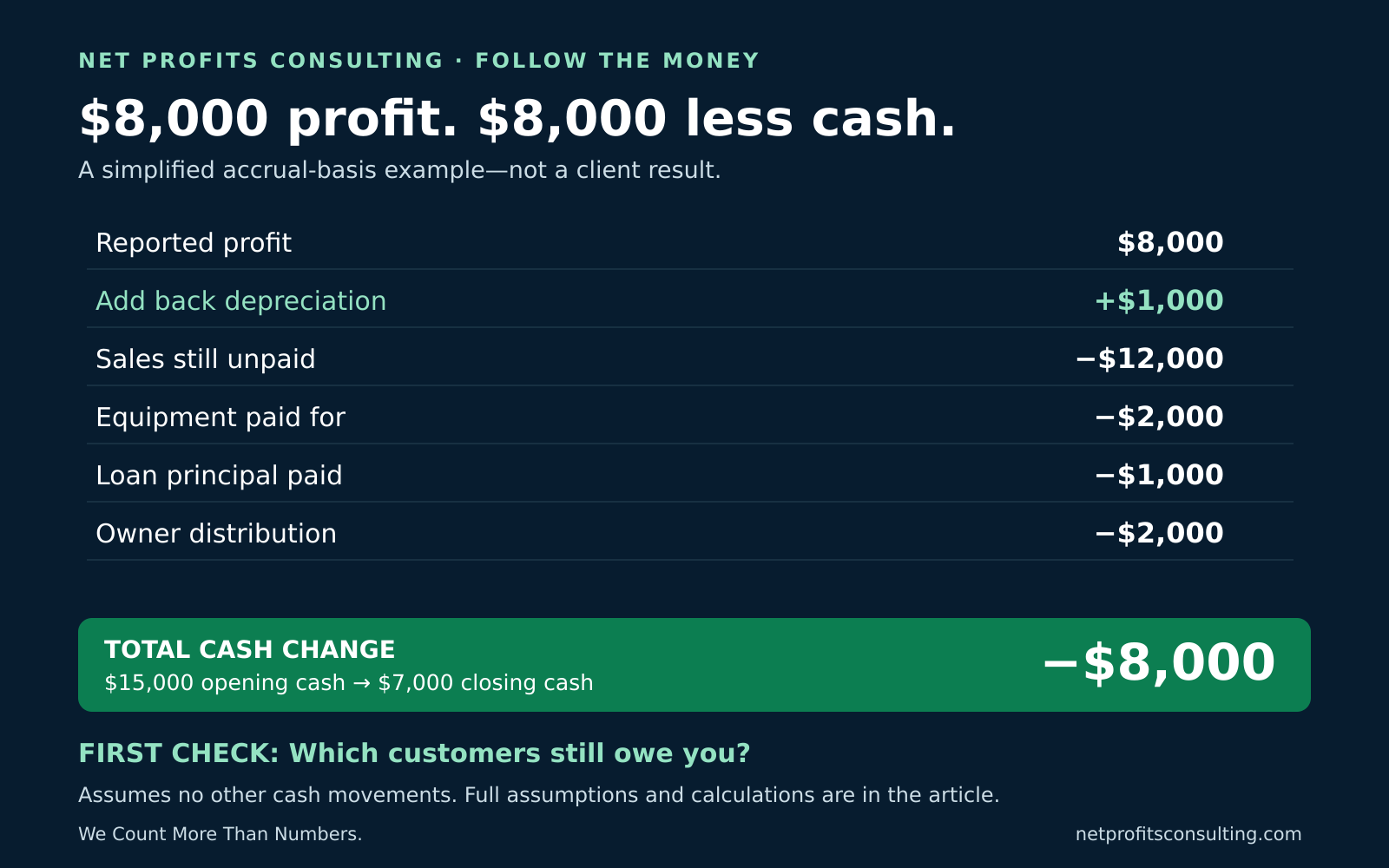
Start with profit and adjust for the items that affect profit and cash differently. The running totals below explain the month’s cash movement; they are not bank balances.
| Starting point or adjustment | Amount | Running calculation |
|---|---|---|
| Reported profit | $8,000 starting point | $8,000 |
| Add back noncash depreciation already deducted in profit | +$1,000 | $9,000 |
| Subtract earned sales not yet collected | −$12,000 | −$3,000 operating cash flow |
| Subtract equipment bought for cash and recorded as an asset | −$2,000 | −$5,000 |
| Subtract loan principal paid | −$1,000 | −$6,000 |
| Subtract owner distribution paid | −$2,000 | −$8,000 total cash change |
The adjustments total +$1,000 − $12,000 − $2,000 − $1,000 − $2,000 = −$16,000. Applying them to the $8,000 profit gives the same result: $8,000 − $16,000 = −$8,000 cash change. These are two ways to explain the same transactions; do not subtract the payments again.
Example assumptions: no opening receivables or collections from earlier periods, no opening or closing unpaid operating expenses, no inventory or prepayment changes, no new borrowing or owner contributions, and no other cash movements or tax payments. The $42,000 expenses include $1,000 depreciation and $41,000 paid expenses. Equipment is capitalized in this illustration; actual accounting and tax treatment may differ.
The largest adjustment is the $12,000 customers have not paid. Review invoice due dates and expected collection dates first. An unpaid invoice may be current or overdue; either way, it is not cash available in the bank.
Profit explains performance. Cash explains payment capacity.
A profit and loss report, balance sheet, and cash flow statement answer different questions. Read them for the same period and use a consistent accounting basis. The SEC’s financial statement guide explains how the cash flow statement connects earnings with operating, investing, and financing cash movements.
Use three questions
- Earned: Did the business generate a profit?
- Collected: Did the money reach the bank?
- Committed: What must that money cover next?
A healthy answer to the first question does not settle the other two.
Profitable but no cash? Check these five places.
1. Customers owe you money
Under accrual accounting, earned revenue can appear before payment arrives. Review your accounts receivable aging report, which groups unpaid invoices by how long they have been outstanding. Separate invoices that are not due yet from late, disputed, or doubtful balances.
Do this: Pick the three largest overdue invoices. Confirm receipt, resolve missing paperwork, and request a specific payment date. Put the expected collection date into your cash plan. An invoice sent is not a deposit received.
For future jobs, consider agreed deposits or milestone billing where appropriate. Changing terms helps only if the terms are clear, accepted, and followed.
2. Cash is sitting in inventory or prepaid costs
For businesses that carry inventory as an asset, purchasing stock can use cash before the related cost appears as an expense when goods sell. Similarly, a prepaid annual cost may use cash up front while the expense is recognized across several months.
Do this: Compare inventory and prepaid balances at the beginning and end of the month. Then identify what you actually bought and paid for. An increase alone does not tell you whether a purchase was paid in cash or remains on a supplier bill.
Before reordering, review stock already on hand, recent demand, and supplier lead times. A volume discount is less attractive when the extra stock leaves too little cash for essential payments.
3. Equipment purchases used cash outside current expenses
A machine, vehicle, or other capitalized asset may use cash immediately while its cost reaches the profit and loss report gradually through depreciation. That timing difference is why the full cash purchase and the depreciation expense need separate attention.
Do this: Review asset purchases and the actual amount paid this period. If a purchase was financed, separate the cash down payment from the financed balance. Do not subtract the entire asset price as a cash payment when only part was paid.
Ask your accountant to confirm how the item is recorded. Avoid changing its classification simply to make profit match the bank balance.
4. Loan payments include principal
A loan payment may include both principal and interest. Principal reduces the debt balance; it is not another operating expense. Interest is tracked separately. Intuit’s QuickBooks Online loan guidance makes this distinction when recording repayments.
Do this: Match each payment to its loan statement. Separate principal, interest, and any charges. Then include the full expected cash payment in your forward cash plan, without counting any component twice.
5. Owner draws or distributions reduced cash
A draw or distribution can take money out of the business without being an expense on its profit and loss report. That is different from properly recorded wages. The treatment depends on your entity and the nature of the payment.
Do this: Review transfers to owners and confirm their classification with your accountant. Plan future withdrawals alongside payroll, supplier bills, debt payments, and tax obligations. A profitable month alone does not establish how much is available to take home.
These five checks are a starting point, not a complete cash flow statement. Payments of old bills, customer deposits, tax liabilities, credit-card activity, and new financing can also explain differences. Include them when they apply.
A 30-minute review when you’re profitable but no cash is left
Use this as a first-pass diagnostic, not a promise that every discrepancy can be solved in half an hour. Start with reconciled records. If the books are incomplete, mark uncertain figures instead of treating them as facts.
| Time | Action | Leave with |
|---|---|---|
| Minutes 0–5 | Choose one month. Compare opening and closing cash across the same business accounts; exclude transfers between them. | The actual total cash change |
| Minutes 5–15 | Review the five areas above alongside your reports and statements. | A list of explained cash movements |
| Minutes 15–25 | List expected receipts and required payments by date for the next four weeks. | The earliest likely shortfall |
| Minutes 25–30 | Choose the largest controllable gap. Assign one action, one owner, and one due date. | A concrete follow-up |
A useful conclusion sounds like this: “Two overdue invoices account for $9,000. I will resolve the purchase-order issue today and confirm collection dates by Thursday.” “We need more sales” is much harder to act on.
Turn the diagnosis into a four-week cash plan
For each week, calculate opening cash + expected receipts − expected payments = closing cash. Carry the closing balance into the next week. Use likely payment dates, not just invoice dates, and keep uncertain receipts clearly marked.
Include payroll, rent, suppliers, taxes, debt payments, planned purchases, and owner payments where relevant. Separate money reserved for obligations from discretionary spending. Check the daily sequence around large payments: a positive Friday balance does not guarantee you can cover Tuesday’s payroll.
Next, move your largest expected customer receipt one week later. Does any balance fall below what you need to operate? If so, act before the due date: follow up on collection, review optional purchases, or discuss payment terms with the relevant party. Do not quietly defer required payments or assume unapproved financing will arrive.
General cash flow guidance from business.gov.au also emphasizes collections, inventory, and the timing of payments. Those operating principles are useful here; the linked page’s Australian legal and tax details are not U.S. guidance.
If you want a refresher on reading the numbers, our free Get Your Business Books in Order course includes a lesson on profit versus cash. Use it alongside your own reports.
Questions owners ask about profit and cash
Can this happen if I use cash-basis reports?
Yes. The unpaid-invoice explanation changes, but loan principal and owner draws can still reduce cash without being profit and loss expenses. The handling of assets and other entries also matters. Always check the basis shown on the report.
Will more sales fix the shortage?
Only if those sales produce enough cash at the right time. A job that requires materials and payroll before collection can deepen the immediate gap. Compare the expected margin and payment schedule before accepting more work.
Does a cash decline mean the business is failing?
No. A planned equipment purchase or debt reduction can lower cash even in a healthy business. The concern is an unexplained decline or a shortage that prevents required payments. Your forecast helps distinguish the two.
Know where the money went before deciding what to do next.
Net Profits Consulting helps small business owners organize their QuickBooks Online books and understand their financial reports. Start with your latest profit and loss report, balance sheet, and the period you want to review.
Discuss Your Bookkeeping Needs →Use the inquiry form to describe the issue. We Count More Than Numbers.
Keep learning with Net Profits
Get practical business education and resource updates.
Sources checked September 28, 2026. Examples are simplified educational illustrations, not client results. Your accounting and tax treatment depend on your business and circumstances.

Leave a Reply